Open the File
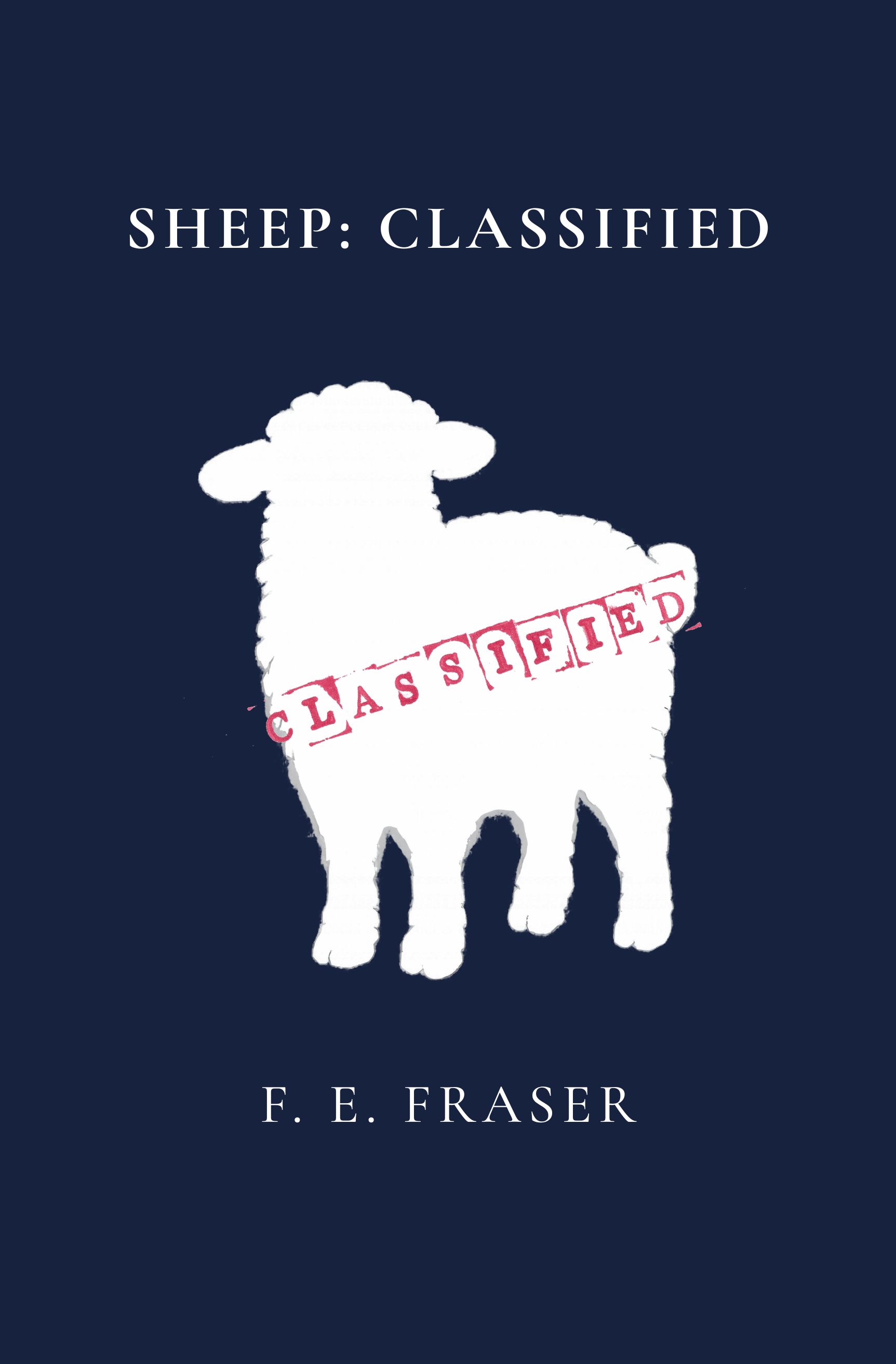
Read Chapter 1 in full, followed by an excerpt from Chapter 2 of Sheep: Classified.
Some books are hard to describe. This is one of them.
A novel crossing six eras, two thousand years, and one very patient sheep.
A novel for readers of literary fiction, historical fiction, and political satire, with time travel, British humour, philosophy, and a sheep with opinions on grass.
Available in paperback and digital editions.
Preview excerpt from Sheep: Classified
by F. E. FRASER.
Copyright © 2026 F. E. FRASER Publishing.
All rights reserved.
* * *
Prefer to read first?
The preview begins just below
For one more person.
.
.
.
.
Is it you?
* * *
There was a cat.
It sat inside a box. Alive, or dead.
You would never know without looking.
This book contains a sheep.
It exists, or it doesn’t.
It is worth reading, or it isn’t.
You would never know without looking.
But you’ve already looked.
* * *
Chapter 1 - Unknown is Not a Place
Chapter 2 - Warwickshire, Sometime
Chapter 3 - London, Sometime
Chapter 4 - New Harmony, Sometime
Chapter 5 - Rome, Sometime
Chapter 6 - Venice, Sometime
Chapter 7 - Neverland, Sometime
Chapter 8 - Delphi, Somehow
* * *
Chapter 1
Unknown Is Not a Place
The telephone rang at seven forty-three on a Tuesday morning, which is hardly the hour at which one expects to encounter anything genuinely strange. Strange things, in my experience, arrive on Wednesdays; Tuesdays are reserved for paperwork.
It was an officer from Animal Health, reporting what he termed a “livestock irregularity”: an untagged ovine loitering in a parish-boundary field down in Wiltshire. I asked whether the beast was injured, and he said no. I asked whether it presented any immediate biosecurity risk, and he conceded that it probably did not, though he made it abundantly clear that the real grievance was the tag.
I promised to be there by nine, opened the drawer, and dug out the district folder. The field had been appearing in government records for decades, usually in connection with crop circles. Officially, each incident was logged under Unexplained Vegetation Disturbance: Possible Livestock Activity, invariably ending with a recommendation for further monitoring that nobody had ever followed up.
Near the back was a yellowing press cutting from September 1991, headlined Men Who Conned the World. It described how two retired men from Southampton had spent thirteen years making more than two hundred crop circles across Wiltshire and Hampshire with nothing more than a wooden plank and a length of rope. The story ran for three days and was considered closed.
Paper-clipped to the cutting was an unsigned memorandum dated 11 September 1991. It contained just three sentences:
Monitoring of designated sites to continue as scheduled. Public interest in this matter is no longer a concern. B. and C. may have served their own unknown purpose.
The field had been on the designated list since 1976, though that had never prevented the plank-and-rope story from being remarkably useful. I closed the folder, picked up my keys, and drove to Wiltshire. I am a man of moderate competence and reliable punctuality, qualities that, in fifteen years of government service, had been asked of me far more often than genius. I arrived at nine precisely.
***
The scene was, as promised, unremarkable.
The sky was grey, and the grass was still wet from the night. A temporary metal gate leaned against a fence post with the settled confidence of something that had been temporary for several years. Two Animal Health officers stood beside their van: one with a clipboard, the other holding a traffic cone for reasons that were not immediately apparent and never became apparent later.
At the centre of the field, inside a formation of flattened grass that had, over the years, attracted the attention of three government departments and a question in the House of Lords, a single sheep was grazing. The circle was precisely the sort of pattern a thorough animal might produce if left alone long enough with sufficient motivation. I made a note to include this remarkably sensible explanation in my report and, for a moment, was rather pleased with it.
She was grazing with quiet deliberation, her ears alert and her body still, only her jaw moving steadily. There was no ear tag, no sign that she had previously been tagged, and none of the customary paint markings used to identify flock origin. When she moved two steps and resumed eating, her gait was even.
Then I noticed that she was looking directly at my right shoe.
Her jaw had stopped, her ears were forward, and she was examining the leather with such steady concentration that I found the scrutiny considerably less comfortable from this side. I shifted my weight, but she merely tracked the movement, looking from my left foot back to my right.
“Your right shoe is pinching,” she said. “Not severely. Enough to alter the footfall.”
I glanced towards the van. The officer with the clipboard was still writing, and the officer with the cone was still looking at the vehicle. Neither appeared to have noticed anything unusual.
When I looked back, The Sheep had resumed grazing.
There are moments in government service when one decides very quickly whether one has truly heard an impossibility. I decided I had not, and maintained this position for approximately four seconds.
Then she lifted her head again.
“You have been compensating,” she said. “It is inefficient.”
My pen stopped moving.
She was right. I had been ignoring the shoe for two weeks. A seam along the inner edge of the right heel had been pinching just enough that, without consciously deciding to, I had begun turning my right foot slightly outward when I walked.
“Everything all right?” the officer with the clipboard asked.
I looked at The Sheep.
She was eating again, her jaw moving with the same measured purpose, her face carrying the perfect blankness of an animal that had never formed a sentence.
“Yes,” I said.
***
I opened my bag and produced Form AH-17A: Unidentified Small Ruminant — Movement Irregularity and Assessment.
In the box marked Species, I wrote Ovine, decided that looked too clinical, crossed it out, and wrote Sheep. The word sat in the box with more confidence than the circumstances warranted, so I amended it to Sheep (provisional).
I continued down the form.
Breed: Unknown. Sex: Female. Age estimate: 3–4 years. Identification number: None. Owner / keeper: Unknown. Holding of origin: Unknown.
By every practical measure, she was a sheep; by every administrative measure, she did not yet exist.
“Unknown is not a place,” The Sheep remarked.
I kept my eyes on the form. Beside the van, the officer with the clipboard was checking transport regulations on his phone, while the officer with the cone had set it down and was standing beside it as though he had found an unexpectedly good companion.
I moved my pen back to Owner / keeper: Unknown.
“Nor is it an owner,” she said.
“So what is it?” the officer with the clipboard asked.
“A sheep,” I said.
He exhaled. “Right. But whose?”
We established that no farm in the parish had reported missing stock, there was no movement licence, no holding number, no microchip returning a result, and no entry in any system available to us while standing in a wet field with a traffic cone.
If no keeper came forward, who bore the cost? If she belonged to nobody, what did the regulations require?
The Sheep continued grazing. She had moved approximately four feet during the discussion, suggesting either indifference or a remarkably efficient grazing strategy.
I could not rule out either.
Under Disposition, the form offered five options: Return to keeper. Quarantine. Transfer. Destroy. Other.
The box marked Other had a line for explanation.
“Is quarantine another word for thinking later?” The Sheep asked, looking at the form with genuine curiosity.
I did not answer. I ticked Other and wrote: No immediate welfare concern. Temporary observation under veterinary discretion. Further assessment required.
It was professionally defensible. It postponed every actual decision while creating the reassuring appearance of procedure.
The officer with the clipboard seemed satisfied. Something had been done, in the sense that a document now existed where no document had existed before.
The Sheep stood in the field and ate.
As I was packing my bag to leave, she asked what she ought to call me.
"Doctor," I said.
She waited in silence, clearly expecting more.
"Doctor Shepherd," I offered. She continued to look at me without blinking. "Doctor Francis Shepherd."
She considered this for a moment. "Is that what you are," she asked, "or what they call you?"
"Both, usually."
"Usually is not always. And you added Doctor each time. Is it important?"
She did not pursue the point, returning quietly to the grass and leaving the question standing in the field between us.
***
Back at the office, I completed the official report. Under Additional remarks I wrote: Subject displays unusual attentiveness. I omitted any reference to her assessment of my gait, our conversation, or her question about what I was.
That evening, I sat by the front door and took off my shoes, leaving the right one until last, as I always did without knowing why. On the inner edge of my heel was a small red mark, tender when pressed. I left the shoes by the entrance and walked through to the kitchen to put the kettle on.
The Sheep was standing by the counter, eating my salad.
I had been thinking about her all day. There is a theory that if you hold a thing in mind long enough, the world will eventually rhyme with it.
I had not filed our conversation.
At the time, this seemed a small distinction.
***
To whoever is holding this file,
What you have just read is an account of the first time I met The Sheep. At the time, I believed I had encountered little more than an unusual administrative problem in a Wiltshire field. I was a government veterinary surgeon; my duties normally began and ended with animals and paperwork, and there were procedures for such things. I had no reason to imagine that this meeting would determine much of what remained of my life, or take me to the people and places recorded in the pages that follow.
The official form was filed while the conversation remained outside the record. That distinction became rather more important than I expected, and I began keeping my own account soon afterwards. I have recorded what I saw, what I heard, whom I met, and what happened to me as accurately as I could. Some of the people in this record were strangers to me when I met them, and several of the places were equally unfamiliar. In some cases, I learned where I had been, or who had been standing in front of me, only afterwards. You may recognise them before I did.
When something seems familiar, unlikely or absurd, check it for yourself. Check the dates, the places and the names where they appear, and the details where they do not. Much of what follows occurred against real events, among real people, and in places that still exist. Do not take my word for any of it when you can consult the record yourself, and then judge accordingly: the people in these pages, what they believed and what they did, The Sheep and me if you wish, and eventually perhaps your own time as well.
You may at first think that these records concern other countries, other centuries, other governments and other people. I did too, and I no longer have that luxury. My concern now is simply to preserve the record, because time has become a problem. There is still more travelling to do with The Sheep, and I do not know how much longer I will be able to continue this account, so I am recording what I can while I can.
The dates and locations below may help, although you can skip them if you prefer. They are listed chronologically rather than in the order in which I experienced them, and you may begin with whichever period catches your interest. Events in one period may cast a different light on another, so you may occasionally wish to look back.
The official record exists only in traces, each surviving copy diverging slightly as it travels. I would prefer to believe this is an editorial problem.
HISTORICAL REFERENCE: DATES AND LOCATIONS
58 BC: Rome
1500: Venice
1580: Warwickshire, England
1826: Indiana, United States
1937: London, England
2005: California, United States
I have deliberately given you no names, as you can find them for yourself. The fact that you are reading this means at least part of the record survived. If, by the end, you believe any of this matters, perhaps the file should travel a little further.
There may not be much time.
Dr Shepherd
Chapter 2
Warwickshire, Sometime
Long before the eyes could catch up, the smell took over: smoke, mud, wet wool, human waste, old straw, cut through by a sweetness that had no business being there.
For several seconds I did not open my eyes. I’ve noticed my body reacts before my mind catches up. My back felt cold, my right shoulder was under pressure, and my left knee was in intense pain.
Then something snorted beside my ear.
I opened my eyes. A pig gave me a once-over and appeared to find me irrelevant. Above it was a grey sky.
Lying in the mud surrounded by farm animals simply does not suit me. My world is one of paperwork, syringes, and earnest discussions with spaniels about dental hygiene. Once, I removed a fishing hook from a Labrador named Gerald while his owner prayed loudly to three separate Christian denominations.
I sat up.
The village around me leaned, plain and simple. The buildings themselves appeared to be engaged in a long, private argument with gravity, and gravity was winning, inch by inch.
Roofs sagged while smoke escaped from holes that were clearly never meant to be chimneys. Chickens moved through the mud with the performative concern of politicians inspecting a crisis of their own making.
It looked, with some precision, like every medieval drama I had half-watched and half-forgotten.
I checked my pockets twice, hoping my phone would somehow appear in the other one. No such luck. My phone, keys, and wallet were missing, as was any helpful note explaining why I’d woken in a field beside a judgmental pig.
The Sheep stood six feet away, entirely consumed by her grass, having witnessed the impossible and promptly moved on to dining. Her ears moved independently, taking in the world. Her mouth worked with steady purpose.
I knew what panicked animals looked like, but this sheep’s absolute calm was considerably more terrifying.
Somewhere ahead, beyond the crooked cottages, voices rose and fell. It didn’t sound like a festival or a brawl. There was an ugly, patient edge to the noise, like people settling in to watch something happen to someone.
I got to my feet as the mud swallowed my boots up to the ankles. The Sheep raised her head, looking past the crooked rooftops toward the steady line of people moving toward the noise.
“There is clover further along,” she said, and resumed eating.
A man nearby stopped short, and the woman behind him walked straight into his back, driving her basket into his spine and sending the turnips into the mud.
“Christ preserve us,” he said.
He was perhaps fifty, worn thin by a lifetime of bad food and hard living. His cap sat awkwardly high on his head, as if it had never fully committed to him. He looked from me to The Sheep, then directly at her mouth, before looking back at me as though I were the alibi he’d waited his whole life for.
“It spoke,” he said.
The woman behind him did not even look at The Sheep. She looked at the turnips.
He pointed at The Sheep, his hand unsteady with something closer to vindication than fear.
“That beast said there is clover further along.”
The woman finally looked at The Sheep. The Sheep chewed with pure, opinionless indifference.
The woman closed her eyes.
“I need to get the bread. My sister’s got that cough again… and I just don’t have the stomach for a talking sheep today,” she said.
“It spoke.”
“You also said the moon followed you home.”
“It is the moon. That is much of its work.” He looked at The Sheep again, then leaned closer to me. “Drake’s men, you heard? Came back with mountains of gold. Pack-horses from Plymouth all the way to London. Good Queen Bess must be smiling. Gold!”
“Good Queen Bess,” she said, “has not got my sister's cough.”
A few passersby had stopped to look, enough to remind the man of the commotion waiting up ahead. He crossed himself with great care, as if filing a formal complaint with Heaven.
Then the roar rose again from down the lane, and private miracles shrank before public business.
The woman gathered her turnips. The man kept his eyes locked on The Sheep as he backed away.
I looked at The Sheep.
“Do not,” I said quietly, “do that again.”
She chewed, which might have meant agreement or simply grass.
Then a young man rounded the corner at a dead run, looking back over his shoulder towards the noise, and ploughed straight into me.
The collision was brief and tidy. He hit my left shoulder, I knocked into The Sheep, and The Sheep held her ground against the mud. She was simply not built to fall. Instead, she acquired a new colour scheme from the knees down.
She glanced at a pool of brown water between the roots of a nearby tree and walked straight in. The muddy water rose to her belly. Then she stepped out and inspected herself. White enough, as makes no difference.
Then she resumed eating.
The young man stood there catching his breath. He looked about sixteen, still deciding what shape he intended to be. His cloak was too thin for the cold and too neatly brushed for someone running that hard. There was ink along the side of one finger.
He looked at me. Then at The Sheep, who was now, strictly speaking, no longer white in any meaningful sense.
Something had fallen in the collision. I noticed it before he did: small and bright, sitting in the mud between our boots. I reached down and picked it up.
It was a gold ring, set with a stone the colour of blood.
He saw it in my hand and looked so relieved he might pass out.
I held it out. He took it and closed his fist around it without a word.
Then he took a proper look at me for the first time, quickly sizing up whether a stranger and a muddy sheep were going to be any help.
He appeared to conclude: possibly.
A passing carter called out, “Will! All well?” without breaking stride.
Will was already moving, and we were already following. I could not have said when that had been decided.
“She cut my cord sixteen years back,” he said, his voice tight. “My mother always said she held me before the light even hit me. She has never asked for anything in return.”
“There was a gentleman whose fever broke under her hands after the physician took his fee and fled. His wife despised her for it. A woman of no breeding had succeeded where men of learning failed, and walked away with a family ring for her trouble. He had to fight his own household just to give it to her.”
“Then let the law run,” I said. “There is time.”
He didn’t answer immediately. His grip on the ring tightened until his knuckles showed white.
“The courts would take weeks,” he said, eyes fixed ahead. “And the law has been against her ever since the Act. But they aren’t waiting for magistrates. The law moves too slowly to give them what they want.”
“What do they want?” I said.
He was quiet for a moment.
“The father lost his boy,” Will said. The words came out tight, as if he had rehearsed them often enough to keep his voice steady. “She gave him medicine that cooled the fever, but he took fright and poured it out. The boy died. The man knows why, but he cannot bear to say it aloud. A witch gives him someone else to blame.”
He stared into the grey mist. “The physician, the grand gentleman with his Latin and the church behind him, opened the boy’s veins. She went down on her knees and begged them to stop. They threw her into the street. The boy bled to death, and the physician still walks with his licence.”
“My father said it was not always like this.” He spoke without slowing. “His father remembered when a woman who knew plants was simply a woman who knew plants. By the time he died, he would not have said so aloud.”
The Sheep moved alongside us, eating as she walked, each mouthful considered. She was, from the knees down, the same colour as everything else in the village that morning.
“There is a man who owes her family money. Eleven years. He will not need to pay it after today.” Will’s voice went flat. The panic had gone. “There is a family she once helped. She blamed their sickness on a neighbour who had been near their well. That neighbour has not forgotten.”
Will’s boots churned through the grey mud.
“There is a wife who decided that an unmarried woman, trusted enough to walk into other people’s houses, must want something she has no right to. Her husband looked once, at a harvest, the way men look. She turned him away. That is not forgiven.” His jaw tightened. He looked at the mud ahead of him. “There are people who have done well and could have helped her, but did not. It is easier to want her gone than to remember that.”
“And the others?” I said.
“Afraid. Most of them.”
The noise ahead had grown denser, thick with shouting, barking dogs, and the restless murmur of men egging one another on. The sound of people who had found their positions and intended to keep them.
“None of them will say any of this,” he said. “They will say she is a witch.” He looked ahead. “One word. It covers everything they cannot say.”
* * *
PUBLIC FILE ENDS HERE
The Sheep has one final observation.
You have already paid with something more valuable than money:
your time and attention.
The remainder is largely administrative.
The healer’s story is not finished.
Neither are Dr Shepherd and The Sheep.
The first two files were the easy ones.
What follows grows stranger, denser,
and considerably harder to dismiss.
London, 1937, is waiting.
So are a man returned from Spain,
and a child the world will one day recognise.
The Sheep cannot account for why the file reached you only now.
She can only suggest that you do not leave the rest unopened.
Chance brought the file to you.
Curiosity brought you this far.
Now, the opportunity is in your hands.
One day, you may look back on today and be glad you opened the full file.
Sheep: Classified is available in paperback and digital edition.
For readers who want the file on the desk, on the shelf,
and a little closer to The Sheep.
For readers who wanted the file yesterday.
For Kindle editions in other regions, please use your local Amazon store.
Direct purchase will be available soon.
Amazon links are affiliate links.
Price remains exactly the same.